
Identifying and solving building problems environmentally without the use of chemicals
+44 (0) 1908 266522

Insect & Pest Infestation
Clothes Moth Infestation
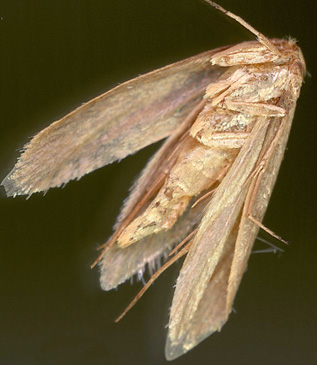
The following types of clothes moths infestation are recorded in buildings in the U.K.
- The common or webbing clothes moth
- Tineola bisselliella (dominant)
- The case-bearing clothes moth, Tinea pellionella
The household clothes moth belongs to the order Lepidoptera and family Tineidae. The flying adults hide in dark areas and shun the light. They lay batches of up to 100 eggs on fur, feathers, skins, wool or soiled silk. Therefore any items in the house made up of the fur, feathers, skins, wool or soiled silk will be at risk of infestation and deterioration.
Pipe lagging if left undisturbed is often warm and this is a particularly favourable site for moths. Modern man made plastic and fibre glass materials are safe from moth attack. Particular hot spots of infestation within the house are the contents of wardrobes, cupboards, drawers and other storage areas, as well as undisturbed areas of carpeting behind and under furniture.
Actively flying clothes moths can be found within the building to some degree and hundreds of adult moths are can be seen actively flying throughout the property in warm weather conditions. Sticky traps in the property with a very high capture rate are an indication of extensive clothes moth infestation.
The adult clothes moths are small, dull, grey/fawn moths, 5-8mm long. The common or webbing clothes moth has more of a golden sheen. Whereas the case bearing clothes moth is more greyish.
The moths scuttle around and only fly when it is warm. Normally they fold their wings along their back when at rest. The head is rather roughly haired, with the proboscis (or feeding tube) reduced or absent altogether. Hence, the adult insects do not feed and it is their larvae (or caterpillars) that damage our fabric. Clothes moths in general are dark-loving insects and, although males and spent females sometimes come to light, they are more likely to scuttle for cover than to fly into the open when disturbed.
Moths of both species can fly in through open windows or doors and can also come from birds' nests in chimney flues or roof eaves. One generation normally takes a year to develop but there are often two generations a year in heated buildings. The larvae, which hatch from the eggs, spin silk webbing.
The larvae are whitish in colour and feed mainly on dried plant and animal material. Clothes moth larvae are among the few insects able to digest the keratin of hairs and feathers. The natural haunts of these insects are the nests of birds and small mammals, from where it is only a short step to human households in which carpets, clothing and general debris provide abundant food. Damage to articles may consist of irregular surface feeding (especially on carpets) or holes eaten completely through the fabric, usually in association with the 'tell-tale' signs of silk webbing produced by the caterpillars.
Wool insulation is very fashionable as an environmentally friendly product and is a good food source for larvae of the webbing clothes moth Tineola bisselliella if it has not been treated adequately.
The solution
A thorough inspection of infested premises is essential to find all sources of infestation before making any attempt at control. Correct identification of the infestation is the key to success. It is important to remember that the adults of these insects do not feed on materials that may be attacked by the larvae. Clothes moths larvae prefer to feed in hidden, secluded and protected places. Larvae will usually be found in wool insulation in cavities and voids, dark clothes closets, on furs, woolens, hair padding, bits of wool carpeting or other such materials in storage.
A variety of monitoring traps are available to catch flying insects. Much can be done to prevent clothes moths problems by means of household cleanliness, including thorough and frequent cleaning of carpeting and upholstery with a vacuum cleaner and brushing, airing, and dry cleaning of susceptible clothing or other articles. Removal of the infested reservoirs and treatment of the infested material is very important to control clothes moths. Rarely, some targeted chemical treatments may be needed.
Beware of someone recommending complete insecticide/pesticide treatment in a building, as this is usually unnecessary, does not address underlying causes, and does not kill all the hidden larvae.
Want to find out more?
For a friendly no obligation chat on this and any of our other services, please give us a call on 01908 266522 or email us on ebs@ebssurvey.co.uk. We'll help you find the right solution to your building problems.

Environmental Building Solutions Ltd.
Passenham Manor
Passenham
Milton Keynes, MK19 6DH
United Kingdom
Regional Offices in:
Dorking (Surrey) & Wales (Powys)
Our Philosophy
EBS improve home and work environments by identifying and curing building problems by environmental means & without the use of chemicals. Our approach causes minimal damage to the building fabric and provides cost-effective long-term solutions.
