
Identifying and solving building problems environmentally without the use of chemicals
+44 (0) 1908 266522

Insect & Pest Infestation
Wood Boring Insects & Death Watch Beetle
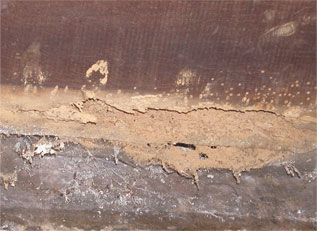
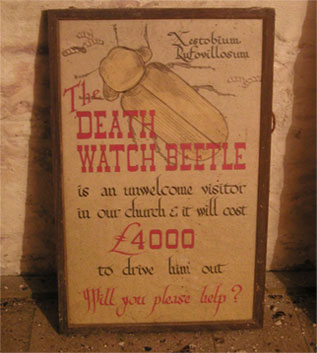
The most common insects that cause decay to timber in buildings are Woodworm (Anobium punctatum) and Deathwatch Beetle (Xestobium rufovillosum). They lay their eggs on the surface of the wood and the hatching larvae tunnel their way into the timber creating galleries. Over a period of time, this may lead to serious structural damage.
Often the insects' activities are not significant, as the timber species may dictate that only the sapwood is consumed, which may only be a small cross-section of, for instance, a floor joist. The adult insects can be seen on timbers during the flight season (April to August), and dust (frass) may also be seen on the floor beneath infected timbers, caused by the insects emerging from the wood. Most old buildings have extinct infestations. These may not need treatment.
However, inexperienced surveyors and those with vested interests will often recommend unnecessary and expensive chemical treatments. This means that extinct outbreaks may have been treated repeatedly over the last thirty years, particularly if a house has changed hands often.
If an active infestation is found, then the circumstances surrounding the attack need to be considered carefully. For instance, does the timber have high sapwood content, what species of timber is it, how wet is the timber and what would be the cost of replacement rather than treatment?
More often than not infestations only require changes in environmental conditions to reduce the moisture content of the wood. For instance, increasing ventilation to a roof void will allow the timbers to dry out naturally and this will eventually eradicate the infestation.
Rarely, some targeted chemical treatments and monitoring may be needed. Beware of someone recommending complete insecticide treatment of all timbers in a building, as this is usually unnecessary, does not address underlying causes and kills natural predators of the insects.
With no vested interest in selling chemical treatments or carrying out building work, EBS Ltd will provide unbiased and informed advice that you can trust.
Want to find out more?
For a friendly no obligation chat on this and any of our other services, please give us a call on 01908 266522 or email us on ebs@ebssurvey.co.uk. We'll help you find the right solution to your building problems.

Environmental Building Solutions Ltd.
Passenham Manor
Passenham
Milton Keynes, MK19 6DH
United Kingdom
Regional Offices in:
Dorking (Surrey) & Wales (Powys)
Our Philosophy
EBS improve home and work environments by identifying and curing building problems by environmental means & without the use of chemicals. Our approach causes minimal damage to the building fabric and provides cost-effective long-term solutions.
